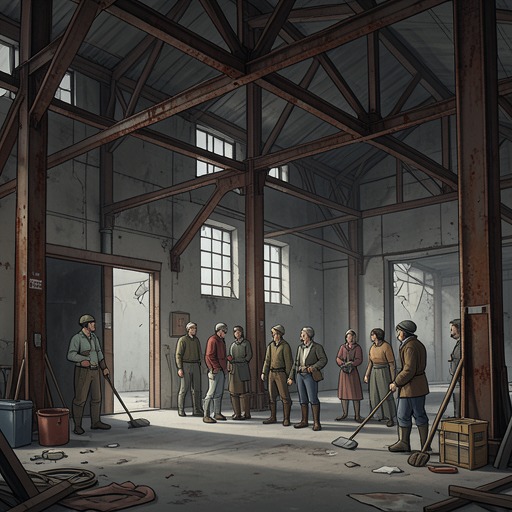
Demolition of the Twenty Mile House
Where'd You Go BernadetteThe demolition of the Twenty Mile House turned a celebrated, carefully made building into an absence before Bernadette Fox even knew that its ownership had changed. Three years of construction were erased in a day, while its architect was in Europe and Paul Jellinek arrived with students expecting to visit it. The event’s aftermath exposed a chain of mistaken identities, left almost no record of the house, and made its loss part of the architectural legacy that later generations were invited to reconsider.
Background: A House Worth Showing
By the time Jellinek brought a class to the Twenty Mile House, it had already attracted attention beyond its immediate circle. In 1992, a visitor affiliated with the MacArthur Foundation asked Jellinek what he considered the most exciting development in architecture. He named Bernadette’s house, at a time when green architecture was being discussed but before LEED, the Green Building Council, or Dwell. Jellinek recalled that visitors expecting an improvised-looking structure instead entered a glass box with clean lines, a concrete floor, and wood walls and ceiling. The counters were exposed aggregate, flecked with broken glass that lent them translucent color; despite the warm materials, the interior seemed lighter than the outdoors.
The house’s appeal was bound up with its material choices and the labor of making them real. When the MacArthur visitors came, Bernadette was building the garage, pouring concrete into forms and making tilt-up walls. They took off their jackets, rolled up their sleeves, and helped. The recognition that followed allowed her to let go of the house and put it on the market. Its eventual demolition therefore destroyed not just a residence but a building that had already become a public example of the work Jellinek considered exciting.
Bernadette had not, however, finished preparing the house for her own record of it. She still needed photographs for her portfolio and chose to wait until the garden had another month to fill in. She planned to have the photographs taken after returning from Europe, and Jellinek had checked with the buyer, who accepted the delay. That arrangement made the later discovery especially stark: a plan to document the completed house was still in place when the house itself was being pushed apart.
The Demolition
Jellinek knew Bernadette was away but did not know that she had sold the house. As he often did, he left her a message that he would be bringing his students by; he had a key. When he turned off Mulholland Drive, the open gate struck him as the first sign that something was wrong. He then saw a bulldozer demolishing the house, and realized there were three. They drove into the walls, broke glass, and crushed beams, furniture, lights, windows, and cabinets. The noise made the scene harder for him to comprehend.
Jellinek ran up to one of the bulldozers, pulled its operator off, and demanded to know what he was doing. The operator did not speak English. Without cell phones available, Jellinek had his students form a line in front of the machines while he drove to the nearest pay phone on Hollywood Boulevard. He called Bernadette and left an answering-machine message in which he protested that she had not told him and that he could not believe she had gone to Europe and destroyed the house. His response registers the distance between what he could see and what he thought had happened: he was witnessing the destruction but did not yet know who had authorized it or why.
The Sale Revealed
Jellinek was away from his office two weeks later when Bernadette left a message asking what he was talking about and saying that she and Elgin Branch were back. He still had the message and played it for the person hearing his account. Bernadette then called her realtor, Judy Toll, to ask whether anything was wrong with the house. Toll initially said she did not know whether Nigel had done anything to it. Bernadette did not recognize the name. Toll explained that Nigel was the English neighbor who had bought the property and had a television show in which expensive objects were dropped from a ladder for someone to catch and keep.
Bernadette believed that a friend named John Sayre had bought the house. Toll then realized what Bernadette had not been told: while Bernadette was in Europe, the business manager had arranged to transfer the title to Nigel Mills-Murray. The manager was buying on behalf of his client, a practice Toll described as a way for celebrities to buy houses in a business manager’s name before transferring title for privacy. Once Toll told Bernadette that Nigel had been the buyer all along, Bernadette fell silent and hung up. The demolition was thus not simply a decision she had knowingly made and communicated; the ownership transfer had been carried out while she was away, under a mistaken understanding of who had bought the house.
Loss, Record, and Public Memory
The Twenty Mile House had taken three years to complete and was demolished in a day. The surviving record was meager: the only photographs were the point-and-shoot pictures Toll had taken as realtor, and the only plans were the comically incomplete drawings Bernadette had submitted to the building department. The contrast between a richly described building and this fragmentary archive gives the loss a second dimension. The house disappeared physically, while the few images and deficient plans became an inadequate substitute for the experience of its materials, light, and construction.
Jellinek resisted a simple account in which Bernadette was only the victim of the demolition. He said he believed the destruction was nobody’s fault but hers, even as the episode left him sickened and unable to imagine what she and Elgin endured. He tried to call her, but the couple sold Beeber Bifocal and left town. Jellinek continued to drive past the site, where nothing remained. His account holds those judgments together rather than resolving them: the house’s loss was devastating, but his loyalty to Bernadette did not prevent him from assigning her responsibility.
Word of the demolition prompted grief in architectural circles. Jellinek gathered architects to sign a letter that ran in the newspaper, and Nicolai Ouroussoff wrote an editorial. The Landmark Commission became more serious about preserving modern architecture, one constructive consequence that Jellinek identified amid the loss. Bernadette never built another house, and she did not attend the ceremony when the American Institute of Architects made her a fellow. Jellinek also questioned what her achievements established about her as an architect: she had built only two houses, both for herself, without clients, budgets, or time constraints, and he doubted that she had the temperament to work for other people. His assessment makes the demolition part of a larger uncertainty about how architectural achievement is judged—by the force of a building, the capacity to practice professionally, or the public recognition that survives after the building is gone.
Twenty years later, the house’s absence itself became the occasion for another architectural undertaking. The Green Builders of America and the Turner Foundation invited architects, students, and builders to submit designs re-envisioning the Twenty Mile House and to consider what building green might mean over the next twenty years. The brief specified a three-bedroom, 4,200-square-foot home at 6528 Mulholland Drive, with the restriction Bernadette had imposed on herself: every material had to come from within twenty miles of the site. The winning design was to receive $40,000 at a gala at the Getty Center. That proposal depended on a paradox: few photographs remained and the plans were largely destroyed, yet the house’s relevance was said to grow with each passing year. The demolition ended the building’s physical life, but did not settle what it could mean as an architectural idea.